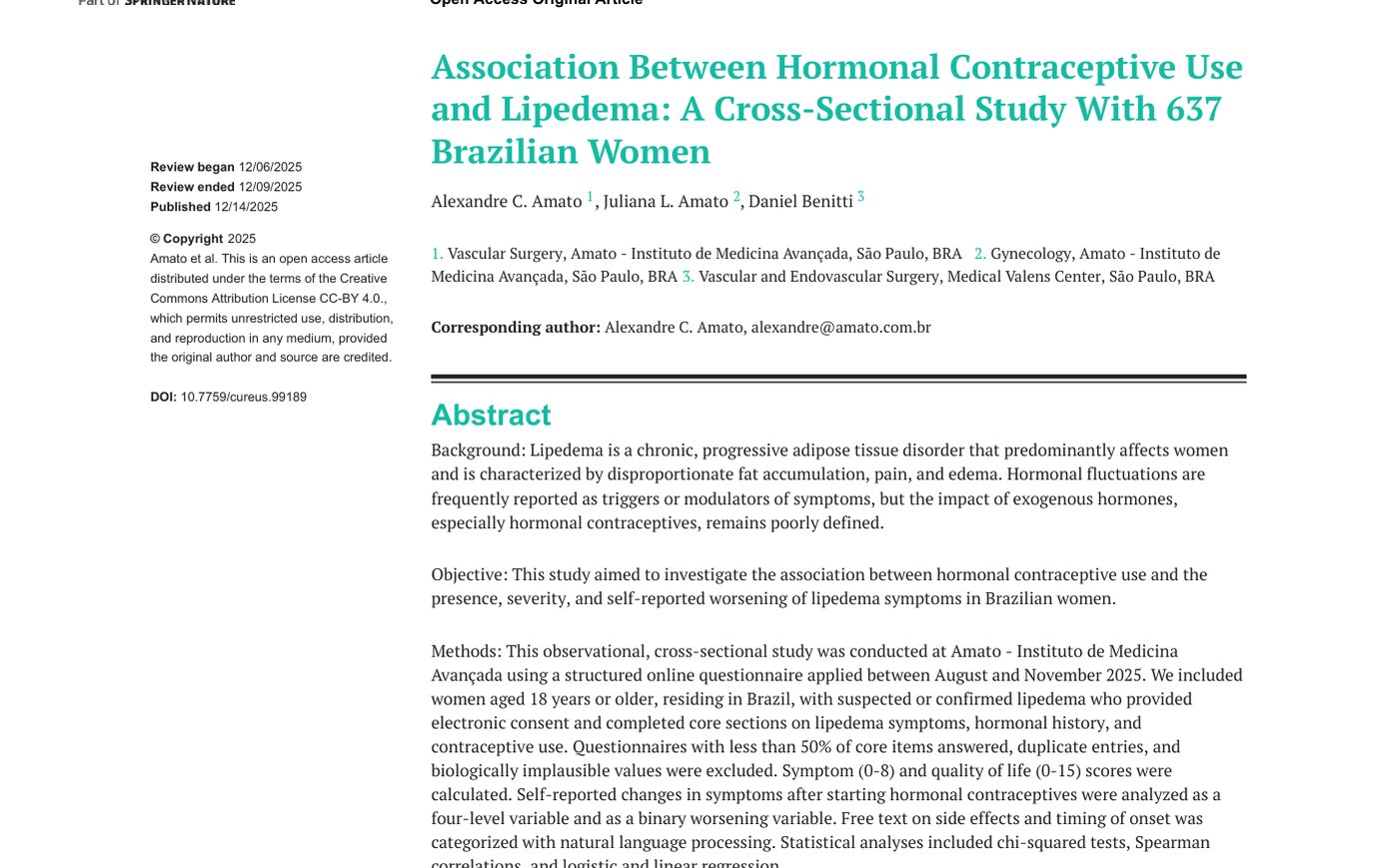
Association Between Hormonal Contraceptive Use and Lipedema: A Cross-Sectional Study With 637 Brazilian Women
Flutuações hormonais são relatadas com frequência como gatilho ou modulador dos sintomas do lipedema, mas o efeito de hormônios exógenos — sobretudo contraceptivos — permanecia mal definido. Este estudo transversal aplicou um questionário on-line estruturado entre agosto e novembro de 2025 a mulheres brasileiras com suspeita ou diagnóstico de lipedema.
Foram incluídas 637 mulheres (idade média 41,8 ± 8,7 anos; IMC médio 28,9 ± 6,4 kg/m²); 77,1% tinham diagnóstico confirmado e 92,3% eram usuárias atuais ou prévias de contraceptivo hormonal.
Entre as usuárias, 58,8% relataram piora dos sintomas após iniciar o contraceptivo — 34,5% piora intensa e 24,3% piora leve —, enquanto 40,3% não notaram mudança e apenas 0,9% relataram melhora (p < 0,001). A análise dos relatos em texto livre, categorizados por processamento de linguagem natural, mostrou que 15,1% situaram o início dos sintomas de lipedema no mesmo período em que começaram a usar o contraceptivo.
Referência completa
Amato AC, Amato JL, Benitti D. Association between hormonal contraceptive use and lipedema: a cross-sectional study with 637 Brazilian women. Cureus. 2025;17(12):e99189. doi:10.7759/cureus.99189
Abstract
Background. Lipedema is a chronic, progressive adipose tissue disorder that predominantly affects women and is characterized by disproportionate fat accumulation, pain, and edema. Hormonal fluctuations are frequently reported as triggers or modulators of symptoms, but the impact of exogenous hormones, especially hormonal contraceptives, remains poorly defined.
Objective. This study aimed to investigate the association between hormonal contraceptive use and the presence, severity, and self-reported worsening of lipedema symptoms in Brazilian women.
Methods. This observational, cross-sectional study was conducted at Amato - Instituto de Medicina Avançada using a structured online questionnaire applied between August and November 2025. We included women aged 18 years or older, residing in Brazil, with suspected or confirmed lipedema who provided electronic consent and completed core sections on lipedema symptoms, hormonal history, and contraceptive use. Questionnaires with less than 50% of core items answered, duplicate entries, and biologically implausible values were excluded. Symptom (0-8) and quality of life (0-15) scores were calculated. Self-reported changes in symptoms after starting hormonal contraceptives were analyzed as a four-level variable and as a binary worsening variable. Free text on side effects and timing of onset was categorized with natural language processing. Statistical analyses included chi-squared tests, Spearman correlations, and logistic and linear regression.
Results. A total of 637 women were included (mean age 41.8±8.7 years; mean body mass index (BMI) 28.9±6.4 kg/m²); 77.1% had a confirmed diagnosis of lipedema and 92.3% were current or previous users of hormonal contraceptives. Among users, 58.8% reported symptom worsening after starting contraceptives (34.5% severe; 24.3% slight), 40.3% reported no change, and 0.9% reported improvement (p<0.001). Free text analysis showed that 15.1% reported onset of lipedema symptoms temporally coinciding with contraceptive initiation. In multivariable analysis, a higher baseline symptom score was the strongest independent predictor of worsening, while duration of contraceptive use was not associated with risk. Pain intensity and BMI were the main independent predictors of quality of life impact.
Conclusions. In this large sample of Brazilian women with suspected or confirmed lipedema, hormonal contraceptive use was frequently associated with self-reported worsening of symptoms, and a substantial minority reported symptom onset around contraceptive initiation. Women with higher baseline symptom burden appeared particularly vulnerable. These findings support individualized contraceptive counseling for women with lipedema and highlight the need for prospective studies with objective measures to clarify causality and mechanisms.
Original abstract as published in Cureus.