Conflicting Molecular Hallmarks of Lipedema Reflect Cell-Composition Confounding: A Reanalysis and Germline Reframing
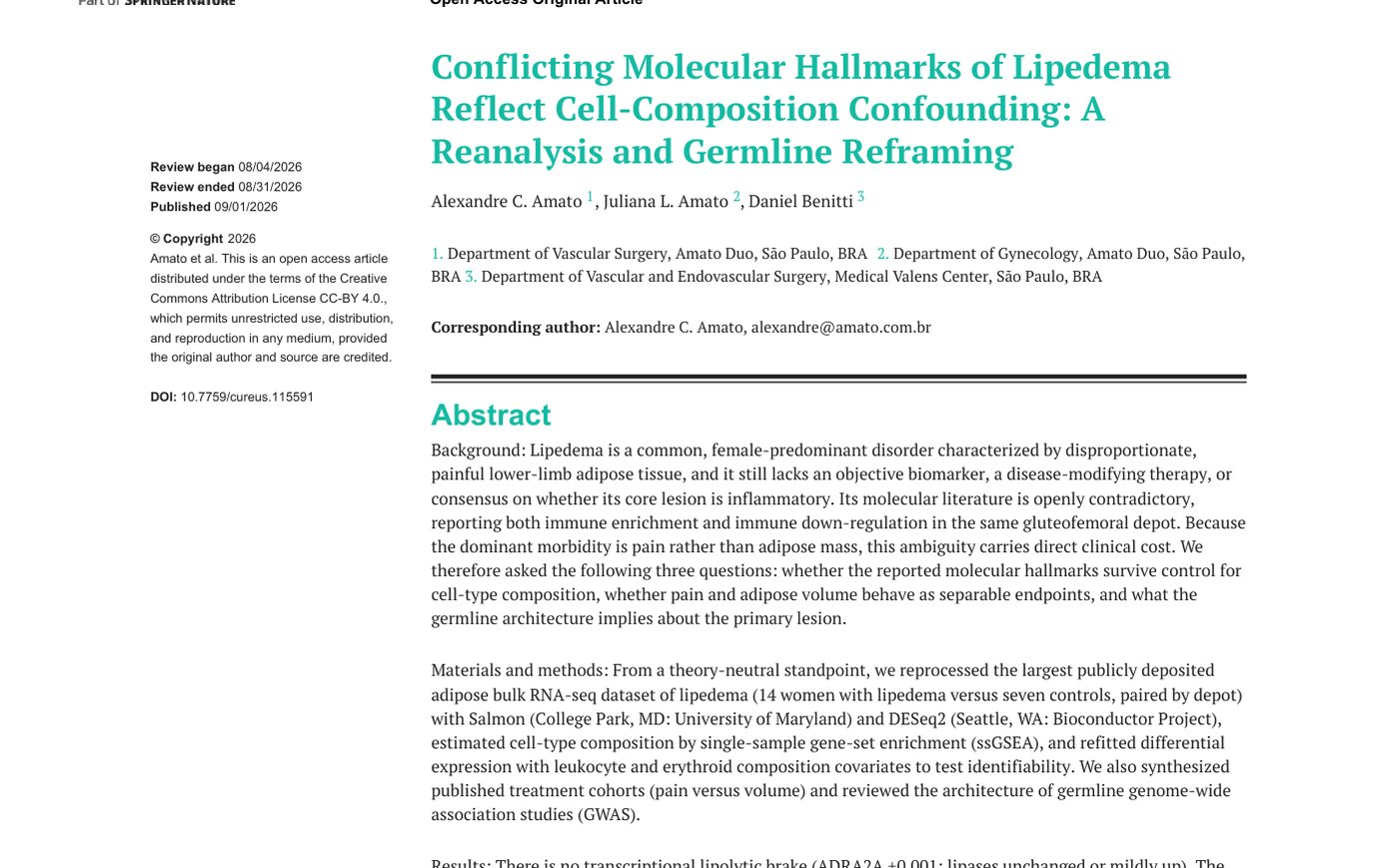
A literatura molecular do lipedema se contradiz: o mesmo depósito de gordura glúteo-femoral aparece descrito ora com sinais de ativação imune, ora de supressão imune. Este trabalho parte da hipótese de que a contradição não é biológica, e sim metodológica — resultado de confundimento pela composição celular das amostras analisadas.
Os autores reanalisam os dados existentes sob essa ótica e propõem um reenquadramento germinativo da doença. O argumento clínico é direto: como a principal morbidade do lipedema é a dor, e não a massa de gordura em si, a ambiguidade sobre a natureza inflamatória da lesão tem custo prático — o campo segue sem biomarcador objetivo, sem terapia modificadora e sem consenso sobre o que de fato caracteriza a lesão central.
Referência completa
Amato AC, Amato JL, Benitti D. Conflicting molecular hallmarks of lipedema reflect cell-composition confounding: a reanalysis and germline reframing. Cureus. 2026;18(9):e115591. doi:10.7759/cureus.115591
Abstract
Background. Lipedema is a common, female-predominant disorder characterized by disproportionate, painful lower-limb adipose tissue, and it still lacks an objective biomarker, a disease-modifying therapy, or consensus on whether its core lesion is inflammatory. Its molecular literature is openly contradictory, reporting both immune enrichment and immune down-regulation in the same gluteofemoral depot. Because the dominant morbidity is pain rather than adipose mass, this ambiguity carries direct clinical cost. We therefore asked the following three questions: whether the reported molecular hallmarks survive control for cell-type composition, whether pain and adipose volume behave as separable endpoints, and what the germline architecture implies about the primary lesion.
Materials and methods. From a theory-neutral standpoint, we reprocessed the largest publicly deposited adipose bulk RNA-seq dataset of lipedema (14 women with lipedema versus seven controls, paired by depot) with Salmon (College Park, MD: University of Maryland) and DESeq2 (Seattle, WA: Bioconductor Project), estimated cell-type composition by single-sample gene-set enrichment (ssGSEA), and refitted differential expression with leukocyte and erythroid composition covariates to test identifiability. We also synthesized published treatment cohorts (pain versus volume) and reviewed the architecture of germline genome-wide association studies (GWAS).
Results. There is no transcriptional lipolytic brake (ADRA2A +0.001; lipases unchanged or mildly up). The apparent immune down-regulation is not identifiable from blood content; adjusting for tissue composition reduces genome-wide-significant genes from 1,501 to four, with blood content correlated with disease at r approximately -0.7, so bulk data can neither establish nor exclude immune involvement, including the NLRP3 inflammasome. Pain and adipose volume are dissociable across treatments, so body weight is a confounded endpoint. The germline architecture reported to date (GRB14-COBLL1, VEGFA, RSPO3, ADAMTS9) is adipo-vascular and extracellular-matrix-based rather than immune, although the largest contributing study defined cases by a bioimpedance proxy rather than by clinical diagnosis.
Conclusions. Lipedema’s inflammatory status is currently undecidable from composition-confounded bulk tissue rather than settled, which explains the field’s contradictory literature; the germline evidence, limited by its case definitions, supports as a hypothesis an adipo-vascular and connective program rather than a primary immune lesion; and pain, not weight, should anchor trials. We specify, but do not perform, the single decisive experiment - paired thigh-versus-abdomen single-nucleus RNA-seq with explicit composition control.
Original abstract as published in Cureus.